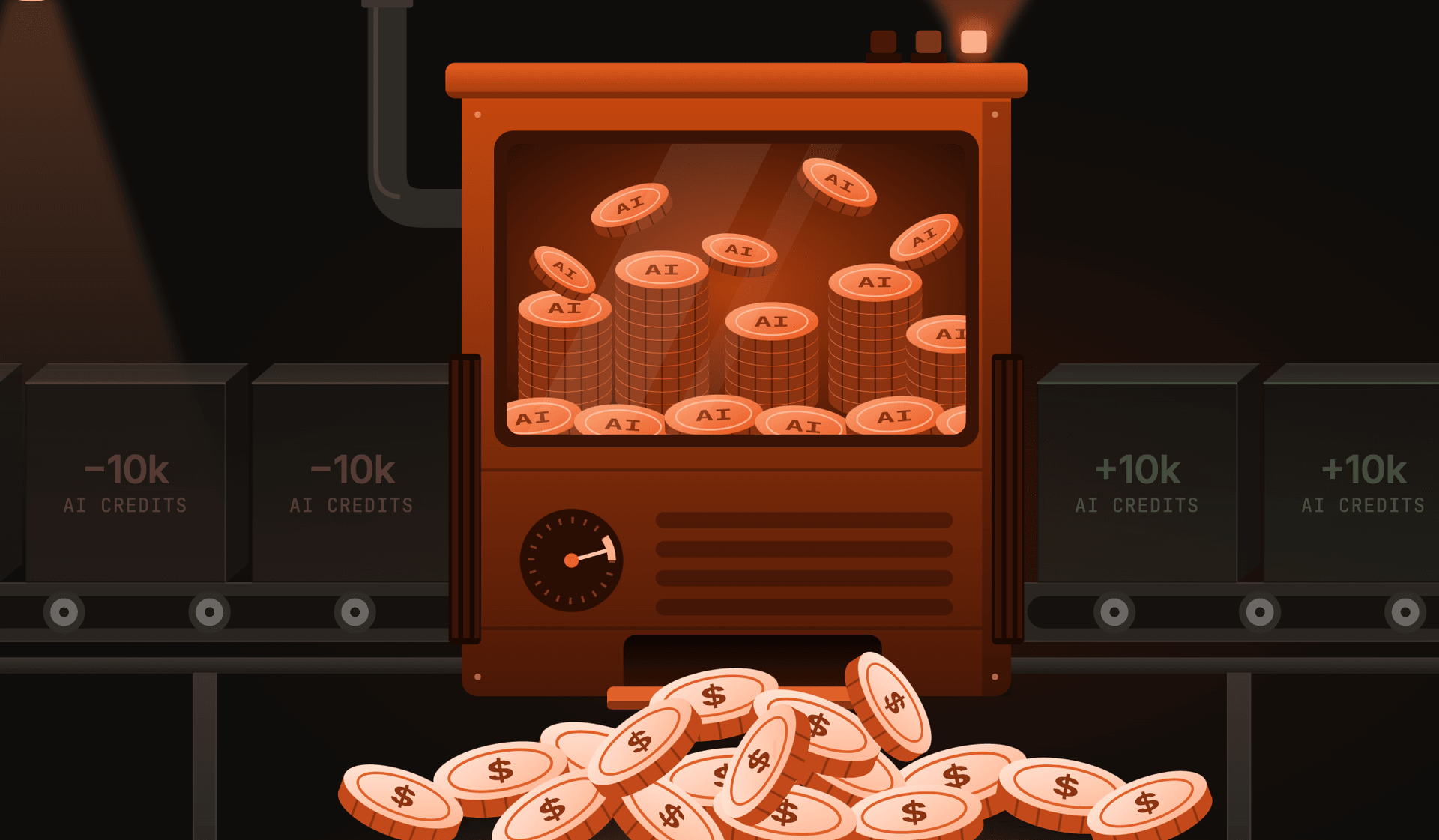
AI tokens and credits have real resale value, and attackers know it. They create fake accounts to farm free trials, take over legitimate accounts to burn through someone else’s credits, fund usage with stolen credit cards, and sell access to anyone willing to pay.
None of these attacks is new, but they've gotten cheaper to run and more profitable to pull off because AI gives attackers both better tools and a brand-new currency to steal: metered tokens and credits.
This post breaks down what AI token abuse actually is, why it's accelerating alongside AI adoption, where traditional defenses fall short, and some step-by-step tips you can use to prevent AI token abuse with device intelligence.
What is AI token abuse?
"Token" is doing a lot of work in modern applications, so it helps to be precise. In the context of AI products, tokens are the units a model reads and writes (input and output tokens), and they’re what providers meter and bill for. Credits, quotas, and free trials are how that usage gets packaged and sold. Session tokens and API keys are a different kind of token, and they matter here only as one way attackers get at that value.
AI token abuse is the exploitation of that metered value. Attackers can steal them, resell them, share them, or mass-produce the accounts that mint them.
Common types of AI token abuse
Free-trial and promo credit farming: Attackers spin up large numbers of fake accounts, each harvesting its signup bonus, free trial, or starter credits — then cash out, resell, or recycle them.
Account takeover: ATO occurs when an attacker gains access to a legitimate account via credential stuffing, phishing, malware, or a stolen session cookie, then depletes the owner’s credits or quota. The victim usually finds out when the balance is gone or the bill arrives.
Stolen payment methods: Attackers use stolen credit cards to fund accounts, buy credit packs, or upgrade to paid tiers, then consume or resell the usage before the chargeback lands. With pay-as-you-go plans, a card on file is enough to incur usage with no upfront purchase at all.
Credential and account sharing: One paid subscription or API key quietly serves dozens of people, so a single seat’s worth of revenue ends up covering far more usage than it was priced for.
Leaked and stolen API keys: A key that leaks into a public repository or a compromised client gets used to send model requests at scale, running up usage (and bills) that belong to someone else. This is sometimes called LLMjacking.
Resale of access: Attackers bundle farmed accounts, hijacked accounts, and stolen keys into cheap access sold through marketplaces, chat groups, and proxy services. Buyers get model usage at a fraction of the list price, and the provider or victims carry the cost.
All of these share a structural weakness: The account, key, or card is trusted on its own merits. If it's valid, it's honored — regardless of who or what is presenting it, or how many times, or from how many different machines.
Why AI is pouring fuel on token abuse
Two things changed with the AI boom, and both favor the attacker.
1. Metered tokens and credits became a currency worth stealing.
AI products are often priced by consumption — generations, API calls, inference tokens, compute credits. Free tiers and trial credits are handed out generously to drive adoption. That combination turns every free account into a small pile of redeemable value.
Farm enough accounts, and you've got a usable (or resellable) stock of AI capability that someone else paid to produce. Hijacked accounts, leaked keys, and stolen cards add to that stock, and resale marketplaces make it easy to turn into cash.
Every farmed credit a provider gives away still costs real inference spend to fulfill, so the fraud lands directly on the provider's compute bill.
2. Automation got cheap, capable, and patient.
The same accessible automation that helps legitimate developers also lets fraudsters craft their attacks: They can script account creation, work around signup friction, and distribute activity across many identities at low cost. Mass account creation and credit farming that used to require real effort now run as commodity operations.
When you combine the metered value of tokens that are worth stealing with the cheap automation to steal it, token abuse stops being a nuisance and starts being a business model.
How to prevent AI token abuse
AI token abuse is scaling because AI made the payoff bigger and the automation cheaper. The defense that matches it isn't a single clever rule, it's a layered approach that gives you the ability to recognize and answer what is behind each account, key, and request: which device, how many accounts it’s tied to, and whether it’s automated.
Device intelligence is how you answer those questions at scale, and it’s what Fingerprint provides: We identify the browsers and devices behind each request. But device intelligence is just one layer, not the whole strategy.
Here are some steps you can follow to build a practical defense strategy for stopping AI token abuse:
- Make leaked keys less costly. Offer scoped keys and easy rotations, and scan public repositories for leaked keys, so a leak doesn’t become free access to models.
- Add account-level spending limits. Per-account spending caps, quotas, and tight usage limits on free trials reduce the damage when an attacker gets through, making each farmed account worth less.
- Tighten payment checks. Stolen cards fund much of this abuse, so pair card verification and your payment processor’s risk tools with device signals at checkout, and limit how much usage a brand-new account can buy before its payment has cleared.
- Run checks where value is created or spent. Signup, free trial claims, credit purchases, and API key creation are the moments attackers have to get through, so that’s where checks pay off most.
- Bind identity to device, not just to the token. Associate the Fingerprint visitor ID with sessions, accounts, and API keys so you can detect when a valid token shows up on an unexpected device, the signal rate limiting and credential checks can’t give you.
- Watch the counting patterns. Use Fingerprint’s Velocity Signals to alert on many accounts per device (farming), many devices per account (sharing), and sudden single-device activity spikes (automation).
- Use Smart Signals to gain more context on activity. Combine Fingerprint Smart Signals like Bot Detection, VPN and Proxy Detection, and Browser Tamper Detection so you can distinguish legitimate automation and privacy-conscious users from abusers, rather than blanket-blocking either.
- Keep humans in the loop at the margins. Route the ambiguous cases, not every user, to step-up verification, so you add friction where risk is, not everywhere.
Fingerprint’s AI token fraud prevention capabilities can fit into a layered defense that stays resilient as browsers and automation evolve.
You can create a free account to get started on your own and explore our visitor ID and Smart Signals capabilities, or check out a free demo and see the platform in action first.
Ready to prevent AI token abuse?
Install our JS agent on your website to uniquely identify the browsers that visit it.
Frequently Asked Questions
What is AI token abuse?
AI token abuse is the exploitation of the metered value in AI products, meaning the tokens, credits, quotas, and free trials that providers meter and bill for. Attackers can steal them, resell them, share them, or mass-produce the accounts that mint them.
Why is AI token fraud so expensive?
Every farmed credit a provider gives away still costs real inference spend to fulfill, so the fraud lands directly on the provider's compute bill. Hijacked accounts and stolen keys also run up usage and bills that belong to someone else, and cheap automation lets attackers do all of it at scale.