Summarize this article with
Recently, I’ve been hearing the question: Which is better for fraud prevention: behavioral analysis or device fingerprinting? And just like the girl in those Taco Bell ads, I say, “¿Por qué no los dos?” This doesn't have to be an either-or decision. Building strong fraud protection without frustrating legitimate customers takes multiple layers of data and analysis. Why limit yourself to fewer signals?
In this post, I’ll walk through where behavioral analysis shines and how it gets amplified when paired with device intelligence to prove that you can have the best of both worlds.
What behavioral analysis does well
When we talk about behavioral analysis in the context of online fraud prevention, we’re referring to analyzing how a user accesses and interacts with a website or application. This includes things like typing and navigation patterns, mouse or touch interactions, timing and sequencing of actions, and how those behaviors change over the course of a session. The goal is to distinguish natural human interaction from automation or abuse by looking at how something is done, not just what happens.
A great example of this is something you’ve probably encountered countless times. Ever see those “I’m not a robot” prompts that only ask you to click a checkbox, and suddenly you’re deemed human? Some don’t even require a click at all. Part of how these work is behavioral analysis, like looking at how your mouse moves, how quickly you respond, and whether your interactions follow patterns that are typical of a real person rather than a script. Subtle signals like hesitation, micro-movements, and natural variation can say a lot without ever interrupting the user experience.
Other examples of behavioral analysis happen over multiple interactions rather than a single moment. Instead of looking at one action in isolation, it evaluates how actions are sequenced across a session, how long it takes a user to move from one step to the next, whether behavior changes after an error or challenge, and how consistently someone interacts with the interface over time. Patterns like an unusually high number of retries, perfectly timed actions, or identical flows repeated across sessions can be strong indicators of automation or abuse, even when each individual interaction appears human on its own.
This kind of behavioral analysis often runs silently in the background, completely unnoticed by users, helping reduce the need for explicit (and usually annoying) challenges or verification steps for the average person. By focusing on how users interact rather than just what they do, it enables teams to detect suspicious behavior as it happens and capture nuances that static signals miss, such as hesitation, self-correction, or abandonment.
Where behavioral analysis alone falls short
But there are some things that behavioral analysis alone simply cannot capture. One of the biggest gaps appears among brand-new users. There is no baseline to compare against and no historical context to lean on when someone first lands on your site. Some types of fraud also happen too quickly or with too few interactions for behavioral analysis to reliably flag them. Promo abuse, referral fraud, and incentive gaming often involve short, clean flows where each attempt appears to be a legitimate first-time interaction, leaving very little behavioral signals to work with, making it easier for bad actors to slip through undetected.
There is also an inherent ambiguity in behavior itself. Perfectly legitimate actions can look suspicious and vice versa. Are those three failed login attempts a fraudster testing credentials from a data breach or just a real user fat-fingering their password? Is a fast, efficient login flow evidence of automation or simply someone using an auto-fill password manager? Without additional context, behavioral analysis is forced to guess, which can lead to false positives, missed fraud, or unnecessary friction for real users.
“Legitimate-looking” behavior is also increasingly easy to mimic. Fraudsters are smart and constantly adapting to changes in security and fraud prevention. Have a rate limit on a page or API? They’ll figure out exactly how long to wait between actions to stay under the threshold and under your radar. Looking for mouse movements that follow mathematical patterns and straight lines instead of human ones? They’ll add jitter, pauses, and randomness to their automation to make it look more natural.
Behavioral signals can also be surprisingly sensitive to factors unrelated to fraud. Small UX changes, accessibility tools like screen readers or alternative input devices, and edge cases such as power users or users on unusual setups can all produce behavior that looks “abnormal” on paper. Without grounding signals to provide context, it becomes harder to tell the difference between someone behaving differently and someone behaving maliciously.
What device fingerprinting contributes
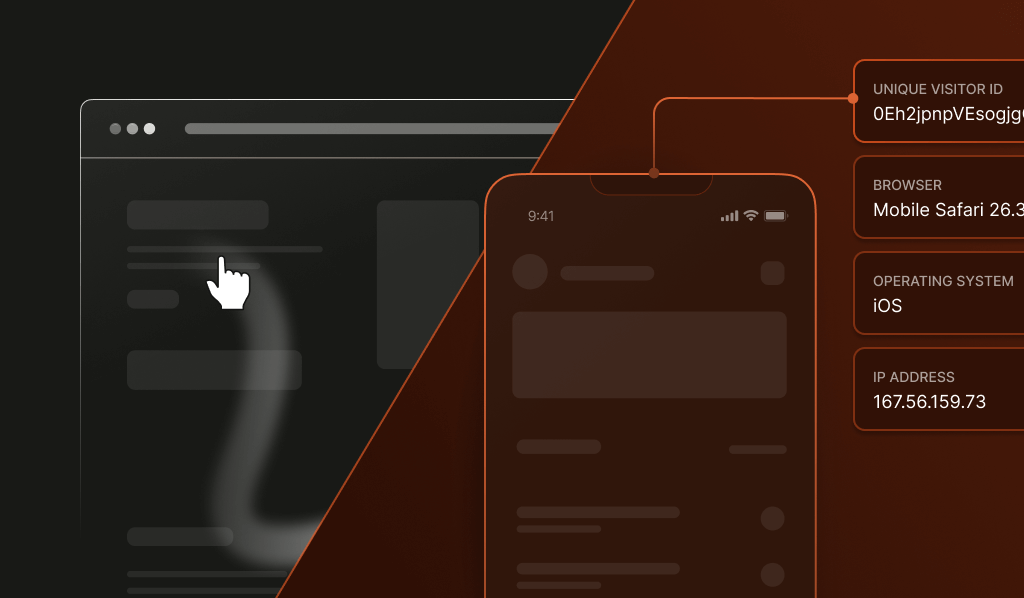
Browser and device fingerprinting focus not on how a user behaves, but on the characteristics of their environment. They combine multiple signals, such as browser version, installed plugins, screen resolution, and how graphics are rendered, to create a unique identifier that can recognize a returning browser or device. This approach does not rely on easily manipulated inputs like user agents or IP addresses, or on data that is frequently cleared, such as cookies. When done well, browser and device fingerprinting produces a stable and durable identifier that can link activity across visits, sessions, and attempts that might otherwise appear unrelated.
Closely related is device intelligence, which uses those same environmental characteristics to assess risk. It can reveal whether a browser has been tampered with, whether a user is operating behind a VPN or proxy, or whether the traffic is likely automated. This context is available instantly when a user arrives, even on their very first visit, providing early insight into intent and surfacing risk signals that behavior alone cannot see.
These signals are also harder to spoof or manipulate at scale. Because fingerprinting draws from a wide variety of inputs, changing or masking a subset of signals is rarely enough to evade detection. In practice, attempts to do so often introduce additional inconsistencies that device intelligence can flag as suspicious.
Unlike behavioral models, fingerprinting is also largely unaffected by UI tweaks, A/B tests, or design changes, making it a stable input even as products evolve. It is less sensitive to accessibility tools or power-user edge cases, and therefore less likely to penalize users who move quickly, rely on assistive technologies, or just interact differently without malicious intent.
Together, these data points establish a strong baseline for real-time decisions that stop fraud while keeping the experience smooth for legitimate users, filling gaps where behavioral analysis has limited visibility.
How the two amplify each other
If it wasn’t obvious by now, the strongest fraud protection comes from combining behavioral signals with device intelligence. Device context adds important grounding to behavioral data and changes how those signals should be interpreted. Someone might move through your site in a perfectly normal way, but device fingerprinting can reveal that the same browser or device has been used across a dozen different accounts. What looks harmless in isolation becomes suspicious when viewed in aggregate.
On the flip side, a device that looks completely “normal” on its own might suddenly stand out once its behavior starts to drift in unusual ways. Combining these signals is where high-confidence decisions to allow, challenge, or block activity really come from.
With more complementary signals in your toolbox, you can catch fraud more effectively without creating unnecessary friction for real users. Power users are less likely to be blocked because you can recognize their activity as coming from a known, trusted device, while a fraudster trying to abuse your free trial can be quickly linked and stopped.
Combining signals also provides better coverage across the entire user lifecycle. Instead of relying on signals that only become useful after enough behavior has accumulated or that only apply in certain situations, you gain visibility from the very first interaction through ongoing usage. It also reduces over-reliance on any single technique, making your defenses harder to bypass as attackers adapt.
A common example where this combination really shines is account creation and early account usage. A new user may move through a signup flow in a way that looks completely normal, typing naturally, navigating at a human pace, and passing basic behavioral checks with no issue. On behavior alone, there is little reason to intervene. But device fingerprinting can reveal that the same browser or device has already created multiple accounts in a short period, or flag environmental signals such as browser tampering or automation frameworks that immediately change the risk profile. Behavioral analysis can then continue to monitor how the account is used, confirming malicious intent through anomalies like unusually fast task completion or repeated retries, allowing teams to stop abuse without disrupting legitimate first-time users.
How Fingerprint helps to build a modern fraud stack
Fingerprint provides industry-leading device intelligence that adds durable context to fraud decisions with a simple, API-first integration. At a high level, Fingerprint collects and evaluates a large set of signals from each browser or device session, including environmental characteristics, network attributes, and indicators of tampering or automation. All of this happens in real time, giving teams immediate context as soon as a user shows up.
At the core of Fingerprint is the visitor ID, a stable identifier that recognizes returning browsers and devices even when cookies are cleared or IP addresses change. This makes it possible to link activity across sessions and accounts that would otherwise look unrelated. For example, what appears to be a stream of new users can quickly be revealed as repeated activity coming from the same device or a small cluster of coordinated devices.
On top of identification, Fingerprint’s Smart Signals surface insights that help explain why something is risky. If dozens of sensitive actions, signups, or account interactions are tied back to the same visitor ID, or if a browser shows signs of tampering, automation, or network anonymization, those signals provide clear, actionable context. This lets teams detect abuse patterns early and respond with confidence, rather than relying solely on downstream behavior.
Fingerprint is designed to work alongside behavioral analysis, not replace it. Because it’s API-first, device context can be used directly in your application logic or passed into existing fraud and behavioral systems.
In other words, device intelligence provides early grounding and cross-session continuity, while behavioral analysis adds pattern recognition and interaction detail. Together, they form a layered foundation for fraud prevention that is more accurate, more resilient, and easier to adapt as attackers evolve.
Better together
Fraud prevention works best when you stop thinking in terms of tradeoffs and start thinking in layers. Behavioral analysis and device fingerprinting each bring important strengths, but together they provide earlier visibility, greater accuracy, and fewer false positives. By grounding behavior in a durable device context, you can make confident decisions that stop abuse without adding friction for real users.
If you want to see how this works in practice, you can start a free trial with Fingerprint or reach out to our team to talk through your use case and see how device intelligence can fit into your existing fraud stack.
FAQ
Behavioral analysis looks at how users interact with a website or app, including typing patterns, mouse or touch movements, timing, and action sequences, to detect automation or suspicious activity.
Device fingerprinting identifies returning browsers or devices based on environmental characteristics, while device intelligence adds risk context, such as browser tampering, VPN usage, or automation signals.
Behavioral signals detect patterns in use and intent, while device intelligence provides context and continuity. Together, they enable more accurate decisions with fewer false positives and less user friction.