In travel and hospitality, trust is no longer earned one transaction at a time.
It’s built across sessions, devices, loyalty programs, and partner ecosystems, and when it breaks, the impact extends far beyond a single booking.
To meet rising expectations for speed and convenience, travel platforms have prioritized removing friction from bookings, account access, and loyalty experiences.
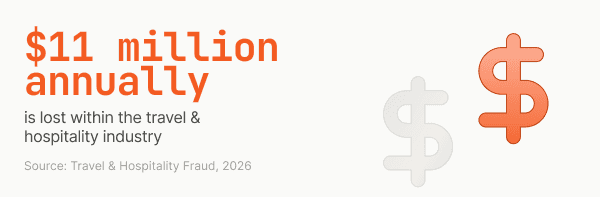
But there is a downside: While removing friction has improved the traveler booking experience, it also has reshaped the fraud landscape. Industry research shows that travel and hospitality companies lose an average of $11 million annually to fraud as a result.
It isn’t just the volume of fraud, but how quickly its effects spread. For instance, a single compromised account can result in stolen loyalty credits, enable fraudulent high-value bookings, and trigger refunds that surface weeks later as disputes.
By the time fraud appears as a chargeback or payment issue, the damage has already moved across systems, partners, and customer relationships.
This report examines how fraud is evolving across modern travel and hospitality platforms, why unified identity and loyalty have become accelerants for risk, and why session-level trust, evaluated continuously and in real time, is emerging as the strategic control point for protecting revenue and loyalty at scale.
The new fraud landscape in travel and hospitality
Scale and convenience have fundamentally changed how travel platforms operate and, in turn, how they are attacked.
Over the past several years, travel and hospitality companies have optimized for speed, flexibility, and seamless access as a competitive advantage. For instance, customers can book flights in minutes, manage reservations across devices, store payment details, and move effortlessly between brands and loyalty programs, often without logging in again. These improvements have raised the bar for customer experience, but they have also expanded the attack surface in less visible ways.
Travel platforms are uniquely exposed because of three structural factors.
Factor 1: Transactions are high-value and time-sensitive
Unlike other industries, fraudsters don’t need to test small purchases or wait for long fulfillment cycles. Last-minute flights, premium hotel rooms, and flexible cancellation policies allow bad actors to extract value quickly, often before anomalies are detected.
Factor 2: Modern travel ecosystems are highly distributed
Bookings touch multiple systems (e.g., airlines, hotels, payment processors, loyalty programs, and third-party partners), each with its own controls, data visibility, and risk thresholds. Not all participants apply the same level of fraud prevention. In some parts of the customer journey, interactions may operate outside traditional payment or identity checks altogether, creating dependencies where fraud controls are uneven or absent.
This creates structural blind spots. When trust breaks at one point in the customer journey, the effects rarely stay contained. Risk travels with the session as it moves across platforms and services, expanding the attack surface through dependencies that were designed for convenience rather than coordinated risk control.
Factor 3: Automation and AI are central to customer experience and operations
From dynamic pricing and chat-based support to automated refunds and itinerary changes, travel platforms increasingly rely on systems designed to remove friction and speed resolution.
However, these same systems can be exploited when attackers appear legitimate, allowing fraudulent activity to scale with minimal resistance.
As a result, fraud in travel and hospitality no longer concentrates at a single moment, such as login or checkout. Account takeover (ATO), loyalty abuse, reservation manipulation, and refund exploitation often unfold across multiple interactions, sometimes over days or weeks. The visible outcome, a disputed charge or chargeback, is typically the final signal, not the starting point.
Fraud exposure translates into measurable financial impact
The financial impact of these downstream fraud events is very real. Industry data shows that travel and hospitality platforms face sustained, material losses.
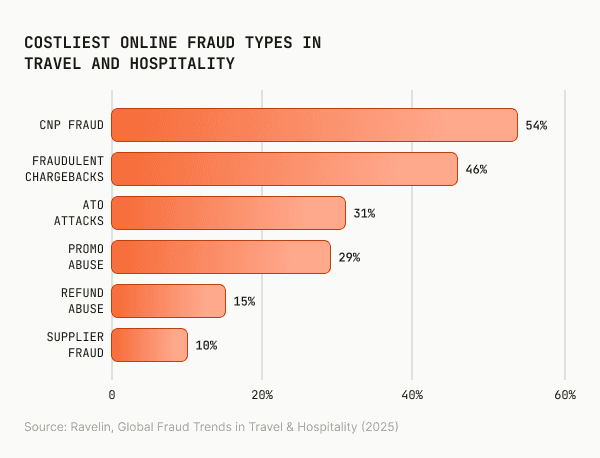
This shift has forced travel and hospitality leaders to rethink how risk is defined and where it should be controlled. Traditional, point-in-time defenses still matter, but they were designed for a simpler model.
In today’s environment, where identity, loyalty, and payments are tightly connected, preventing fraud requires understanding how trust evolves and deteriorates across the entire customer journey.
When identity becomes an accelerant
Unified identity has become a cornerstone of modern travel platforms. Single accounts simplify login, enable cross-brand access, and support personalized experiences across booking, loyalty, and post-trip interactions. For travel platforms, this reduces friction and improves conversion and retention.
But the same consolidation that improves experience also concentrates risk.
When identity systems are unified, access extends far beyond a single transaction. A compromised account can expose stored payment methods, loyalty balances, booking history, and personal data across multiple services at once. What might have been a localized incident becomes an entry point into a broader ecosystem.
One-time passcodes and multi-factor authentication (MFA) reduce some attack vectors, but they operate at one point in time. Social engineering, credential reuse, and account recovery abuse continue to bypass these controls, especially when attackers maintain a consistent, legitimate-looking presence. Once access is granted, downstream systems often treat the session as trusted.
Access then spreads across brands, partners, and workflows, allowing fraud to move laterally rather than remaining confined to a single interaction. Loyalty programs are particularly vulnerable because stored value and flexible redemption options create immediate incentives for abuse.
Fragmented identity blocks personalization, but unified identity without continuous trust evaluation introduces a different risk: speed without context. Credentials alone cannot reflect how trust holds up over time.
In modern travel ecosystems, identity must do more than grant access. It must also support ongoing trust decisions as sessions evolve, before value is extracted and before damage escalates.
Loyalty programs are now a primary fraud target
Loyalty programs are designed to reward long-term engagement. However, they also represent stored value, making them an attractive target once an account is compromised.
As travel platforms unify identity across brands and services, loyalty balances become easier to access, transfer, and redeem. Points and miles can be converted into flights, upgrades, and hotel stays, or resold through secondary markets, often with fewer controls than traditional payment methods.
Industry research estimates that rewards fraud now accounts for $1 billion to $3 billion in global losses annually, underscoring how loyalty programs have evolved from marketing incentives into high-value targets for fraud.
Loyalty has become currency
Unlike card fraud, loyalty abuse doesn’t always trigger immediate alarms. Redemptions often look legitimate, follow expected patterns, and occur within trusted accounts. For fraudsters, loyalty programs offer a way to extract value quickly with less friction and lower visibility.
Account takeover is the entry point
Account takeover (ATO) is the most common path into loyalty abuse. Industry research indicates that more than half (52%) of loyalty fraud incidents involve ATO, which helps explain how frequently compromised credentials serve as the initial point of entry.
Once account access is gained, attackers can drain balances, redeem rewards, or change account details to lock out legitimate users. Because access appears valid, loyalty systems rarely challenge these actions in real time.
Friction creates a false tradeoff
This dynamic creates a difficult decision for travel and hospitality leaders. Adding friction to loyalty workflows can reduce abuse, but it also risks undermining the experience these programs are meant to protect. Research on guest behavior shows that friction during payment and account interactions is a leading driver of abandonment and dissatisfaction, which helps explain why loyalty experiences are easy to undermine.
However, reducing friction has its downsides: Customers notice when points disappear, redemptions fail, or rewards lose perceived value. That erosion of trust often causes more lasting damage than a temporary service disruption.
Loyalty abuse rarely stays contained
Drained balances frequently lead to refund requests, rebookings, and customer support escalations. In some cases, compromised loyalty accounts are used alongside stored payment methods, increasing both financial loss and operational burden. What begins as points theft can quickly expand into broader platform risk.
For instance, high-profile incidents involving third-party loyalty infrastructure providers show how quickly this can happen. When attackers gain access to loyalty accounts early in the customer journey, they can drain points or redeem rewards before the impact reaches customer support, payments, or recovery workflows.
As loyalty programs continue to evolve from marketing tools into core components of the customer journey, they require the same level of risk scrutiny as identity and payments — and protecting loyalty value without introducing unnecessary friction depends on understanding whether a session can be trusted, not just whether a user successfully logged in.
From fraud event to financial risk
Fraud in travel and hospitality rarely announces itself at the moment it begins. Instead, it surfaces later, often as a refund request, a dispute, or a chargeback, after value has already been extracted.
Chargebacks are a lagging indicator
By the time fraud reaches payments teams, it has usually passed through multiple systems. A compromised account may have enabled loyalty redemptions, flexible cancellations, rebookings, or customer support interactions before a disputed charge ever appears. What looks like a payment issue is frequently the final signal of a much earlier breakdown in trust.
In fact, chargebacks continue to rise by 30% year-over-year across the hospitality sector, adding billions in direct costs annually. But those increases don’t point to where the fraud starts; they show where the financial impact finally lands.
Financial impact extends beyond lost revenue
Chargebacks introduce direct financial loss, but they also create operational and network-level risk. Dispute handling consumes internal resources, increases processing costs, and exposes platforms to scrutiny from payment processors and card networks. Elevated chargeback ratios can trigger higher fees, reserve requirements, or limits on payment flexibility, placing additional pressure on margins.
Operational costs compound quietly
The impact extends beyond payments. Refund abuse and disputed bookings often generate customer support escalations, manual reviews, and exception handling across teams. In high-volume environments, these costs accumulate quickly, creating internal friction even as platforms work to remove friction for customers.
Downstream controls are already too late
Critically, tools designed to manage refunds, disputes, and chargebacks engage only after fraud has occurred. By the time these systems respond, trust has already been assumed across identity, loyalty, and booking workflows. Recovery mechanisms can limit damage, but they can’t prevent fraud from spreading.
Recent data shows that reputational damage often outlasts the fraud event itself. Even when a disputed charge is reversed, or a false chargeback is resolved, the loss of confidence is harder to repair: Customers remember failed redemptions, locked accounts, or disrupted trips long after balances are restored.
For travel and hospitality leaders, the challenge is no longer how they can recover losses. Instead, it’s how to prevent becoming a financial and operational burden in the first place. Managing risk effectively requires earlier intervention, before fraud manifests as a dispute and before its effects ripple across the business.
What travel and hospitality leaders are learning
As fraud pressure increases, travel and hospitality leaders are rethinking long-held assumptions about prevention, friction, and customer experience.
One lesson stands out: protecting revenue doesn’t mean sacrificing conversion.
As a result, over the past several years, travel and hospitality platforms have increasingly shifted fraud prevention earlier in the customer lifecycle, focusing on risk evaluation during account creation and early engagement rather than relying solely on post-transaction controls.
Across large travel platforms, teams are moving away from blunt controls and toward more precise, data-driven approaches that evaluate risk earlier in the customer journey. Rather than reacting to outcomes, like disputes or refunds, they are focusing on the signals that precede them. These often include device-level indicators, such as signs of device tampering, rooted devices, or unusually high booking activity from a single device. While uncommon in legitimate transactions, these patterns have proven to be strong predictors of fraud.
More data reveals patterns that single checkpoints miss
Leaders report that many high-impact fraud events are preceded by subtle signals that appear insignificant in isolation. When evaluated together, however, these signals become highly predictive. In other words, the challenge isn’t a lack of signals, but visibility and context, and understanding how signals relate to one another across a session.
This has shifted attention away from single checkpoints and toward continuous evaluation, where risk can be assessed before value is extracted.
Rare signals can be highly predictive
Some of the most useful indicators aren’t the most common ones. Signals that appear infrequently can still carry outsized risk when they coincide with specific behaviors or changes in an account’s state, such as recent credential recovery, profile updates, or access to stored value.
Identifying these patterns requires both breadth of data and the ability to evaluate them in real time, without slowing the experience for legitimate users.
Low latency matters at scale
At the volumes modern travel platforms operate, timing is critical. Risk decisions must be made fast enough to intervene before bookings are confirmed, rewards are redeemed, or refunds are processed. Delayed decisions reduce effectiveness and increase reliance on downstream recovery.
Teams that prioritize low-latency validation are better positioned to contain fraud early, while preserving the speed customers expect.
Prevention doesn’t have to hurt conversion
Perhaps most importantly, leading platforms have validated these approaches through testing. By running controlled experiments, teams have shown that more accurate, session-level risk evaluation can reduce fraud without affecting conversion or customer satisfaction.
This means companies no longer have to choose between security and experience. Instead, by applying controls selectively, travel platforms can reduce friction for trusted users while increasing friction for suspicious ones, protecting conversions and revenue.
The shift to trusted sessions
As travel platforms rethink fraud prevention, one thing is becoming clear: trust can no longer be established once and assumed indefinitely. In modern travel ecosystems, trust must be continuously evaluated as sessions evolve.
Trust is no longer a point-in-time decision
Credentials and one-time authentication checks still play an important role, but they were designed for a narrower risk model. They confirm who is logging in, not whether the behavior that follows should be trusted. When access is granted based solely on credentials, downstream systems often inherit that trust by default, even as risk changes.
Session-level evaluation changes where intervention happens
Trusted sessions take a different approach. Instead of making a single decision at login or checkout, session-level trust evaluates signals in real time across the customer journey. As users browse, book, redeem rewards, or request changes, trust is reassessed based on context, behavior, and consistency.
This allows platforms to intervene earlier (e.g., before loyalty value is extracted, bookings are finalized, or refunds are processed) rather than reacting after fraud has already occurred.
Precision reduces friction for trusted users
Evaluating trust continuously makes fraud prevention more selective. Low-risk sessions move through the experience uninterrupted, while high-risk activity can be challenged or contained. This reduces unnecessary friction for legitimate customers and avoids broad controls that slow everyone down.
Trusted sessions align security and experience
For travel and hospitality leaders, this model resolves a long-standing tension. Fraud prevention no longer requires choosing between protecting revenue and preserving conversion. By focusing on session-level trust, platforms can apply controls where risk is present and remove them where it’s not.
Evaluating trust earlier in the customer journey
As fraud continues to evolve across travel and hospitality platforms, many teams are reexamining how trust is established and maintained throughout the customer journey. When identity, loyalty points, and payments are tightly connected, preventing fraud depends on identifying risk early, before it spreads across systems and services.
Session-level trust, supported by real-time device intelligence, provides a way to evaluate risk continuously as sessions evolve. By intervening earlier, platforms can reduce fraud exposure and protect revenue, while preserving the seamless experiences customers expect.
To learn more about how trusted sessions can support earlier, more precise fraud prevention across travel and hospitality ecosystems, explore how Fingerprint approaches real-time trust decisions.