Introduction
The draw for consumers to banking services at modern fintech companies is clear: Open an account quickly, get approved at checkout in seconds, and move money instantly. All digital.
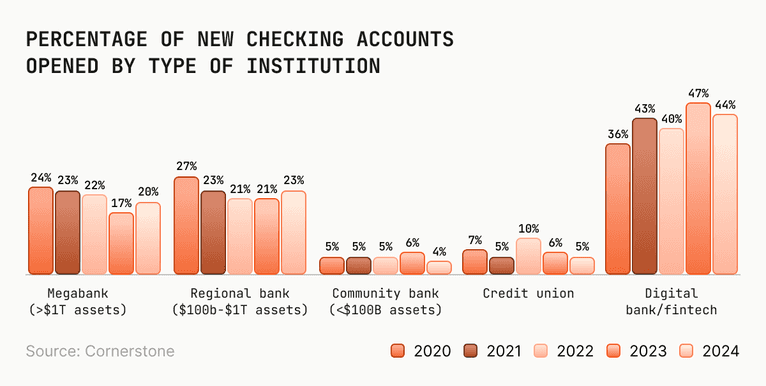
And the shift in consumer behavior exemplifies that this draw is working: Digital-first platforms and financial technology companies secured approximately 44% of new account openings in 2024. In comparison, the combined market share of traditional megabanks and regional institutions barely reached 43%.
However, as these fintech disruptors continue to build for speed and scale—and continue to integrate more customer-first products under their umbrella—there is a structural problem occurring.
The problem is fragmented identity. And for multi-product fintechs, this problem is costing real dollars.
The fintech paradox: More products, less visibility
Fintech platforms process billions of transactions across multiple financial functions, including activities like payments, Buy Now Pay Later (BNPL), and stock trading. Yet they often cannot answer a simple question about visitors across their products: “Is this the same person?”
Every product team evaluates visitors, customers, and risk on its own terms—with little to no shared data across the other products on their platform.
The result is a clear paradox. The more products a platform adds to enhance the customer experience, the wider the gap grows between what they know about their customers across the entire platform.
A customer trusted across years of payment history becomes unrecognizable the moment they move to another financial product, hindering that returning user experience and making it easier for fraudsters to exploit.
For example, someone who’s been making P2P payments in one product, or on-time installment payments in a BNPL product, moves to a different financial service under the same umbrella company because they want to take out a SMB loan. They are treated as a fully new customer and have to restart.
Unfortunately, this is not a data quality or KYC (Know Your Customer) problem. It is a problem that happens when trust is evaluated independently per product with no continuity among them.
The forces that created this problem were actually acting entirely rational. Acquisitions brought incompatible identity stacks. Product teams were measured on vertical metrics with no horizontal ownership across the entire infrastructure. And as AI reshapes workflows and how teams manage their fraud defense, the problem is compounded.
More static rules are added to compensate in an attempt to boost detections—but these only create more friction for users and increase false positives, further deepening fragmentation rather than resolving it.
Trust does not travel
When a customer applies for a loan on a fintech platform, where they have been a deposits customer for years, the lending product asks, “Does this applicant qualify right now?”
They pull a credit file, run a verification check, and evaluate the application in isolation. The customer’s years of history from the deposits product do not enter any trust decisions for the loan. They live in a different silo and are evaluated by a different team.
While this form of fragmented identity hurts legitimate customers, the checks in place are not the problem. The problem is that their fundamental design only evaluates at a point-in-time, not the person the platform already knows.
The hidden costs of this negative user experience start to compound. Customer churn, lost cross-sell opportunities, and unnecessary step-up challenges are all a result of the fragmented identity architecture in place.
Instead of asking, “Does this applicant qualify right now,” the individual products should be asking, “What do we already know about this applicant?”
A continuous device intelligence layer enables this. It operates entirely behind the scenes, invisible to the customer, generating a stable identifier that can persist across sessions, across products—even through spoofing and evasion attempts, privacy changes, and evolving fraud tactics.
Continuous device intelligence as the missing layer
Though legitimate trust does not travel, fragmented identity visibility lets fraud do exactly that. Fraud does not stay in one place. It moves. An account that looked clean at approval could be a mule account moving money or defaulting on BNPL loans by day thirty.
This is why device intelligence signals are so valuable to fintechs right at onboarding. They are one of the few tools that can catch fraud before it moves. Device spoofing, emulator farms, and fraud rings that pass automated ID verification are all detectable at the device layer without adding a single step to the customer journey.
For a legitimate customer, the result is frictionless onboarding. For fintechs, the same layer can reveal whether seven new accounts opened in one day all came from the same device, stopping fraud before it moves downstream.
Here is what it can look like in practice for a legitimate customer: A trustworthy user attempts to open a new loan account. Device intelligence returns various signals: No association with previously flagged IPs, no overlap with fraud infrastructure or tampering present, and minimal activity. As a result, the risk score stays low, additional checks and manual review do not fire, and the customer moves through the onboarding journey without friction.
Now look at a bad actor moving through a BNPL flow without device intelligence in place: Take a fraudster who finds a real Social Security number with no credit history. They attach a fabricated name and address, build up payment history over time, and construct a credit file. Now they have a record. They apply for multiple BNPL installment loans (which all happens at every checkout in seconds)—the data matches, the check passes, they get approved and secure (fraudulent) funds.
Without device intelligence, the fraudster has been able to seamlessly complete all transactions with nothing connecting the malicious activity. With device intelligence, the same visitor identifier would have linked all the installment loans across all the checkouts and could have stopped the transactions before they completed.
The increasing use of generative AI and automation is only amplifying the problem by making exploitation scalable. Synthetic identities get deployed across multiple account types, AI-generated documents pass systems and get re-used, and emulator farms simulate thousands of "unique" users to open new accounts with signup bonuses again and again.
For all points in the customer journey—account origination, transactions, payments, and investing—a persistent device intelligence layer is the link that connects not only trustworthy behavior, but also suspicious, high-risk behavior.
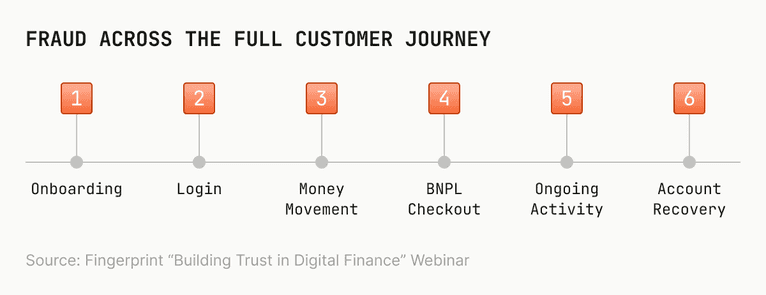
For lean fraud and risk teams, this link lowers manual review needs and dispute-resolution cases downstream.
For compliance teams, signal data can improve operational efficiency, as well. A layer that provides multiple, discrete signals on a session—or several sessions over time—gives them more in-depth information for analysis, as opposed to one opaque score or a single moment-in-time view.
This is more valuable evidence, and can provide a clearer audit trail, to directly protect fintechs against large regulatory fees and attrition.
The four key benefits of unifying identity through device intelligence
Multi-product fintechs have spent years optimizing individual products to deliver the speed, simplicity, and convenience customers prefer. But optimizing for individual products leaves a big gap at the platform level: identity. Device intelligence is the layer that can connect identity across products, letting trust compound across the entire customer relationship rather than reset at every product boundary.
Unifying identity through device intelligence can deliver four key benefits:
- Reduced fraud losses
- Increased cross-sell conversion
- Lowered compliance overhead
- Reduced operational burden
Scaling fintechs with a variety of financial products operating under their umbrella will also benefit with greater visibility of both return customers and fraudulent activity, turning identity fragmentation into an advantage instead of a liability. The ability to catch fraud patterns earlier and link fraudulent activity across accounts and products can continue to add value to the business over time.
For the product and fraud teams who are already being asked to do more with less, these benefits translate into meaningful returns on their investment in a device intelligence layer.
Device intelligence for stronger fraud defense in fintech
If you’d like to see how Fingerprint can strengthen your fraud defense, contact our sales team for a personalized demo. We can discuss your specific use case and business needs, including the ways device intelligence can help prevent account takeover, origination/onboarding fraud, payments fraud, and loan fraud—without impacting your returning customer experience.
To dive deeper into topics like fragmented trust, evasive fraud patterns that beat detection, the friction dilemma, and what top-tier fintechs and digital banks are doing to navigate these issues today, watch our on-demand webinar Building Trust in Digital Finance.