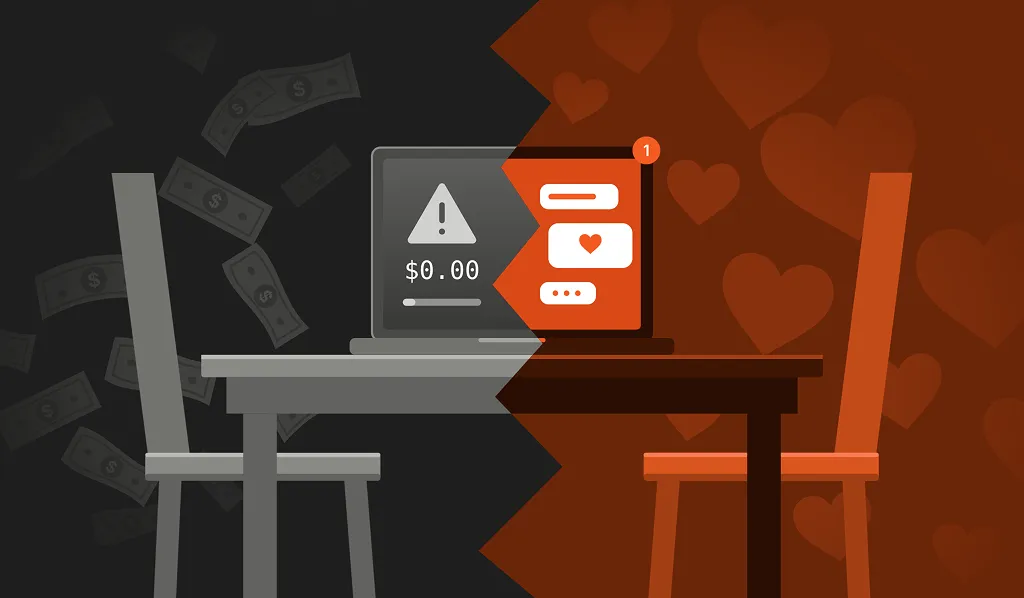
Just last month, the DOJ charged 6 men accused of posing as women on dating sites. Prosecutors say they persuaded victims to connect their cryptocurrency wallets to fraudulent NFT investment sites, then stole their money. The FBI tied the scheme to about 800 victims.
According to prosecutors, the scam ring saved contacts in the phone as descriptors to remember them by, terms like “Bob/soft Ware Engineer/50/Pheonix/devorced.”
Bob thought he met someone, but he was just a line in a contact list, typo and all.
This is the world of romance scams, and it's a problem Fingerprint addresses with a Smart Signal called Active Call Detection.

In this post, we'll look at the state of romance scams and vishing (voice phishing) today, and share some step-by-step instructions for using Fingerprint to prevent this malicious activity.
What are romance scams?
A romance scam is a type of fraud in which a criminal builds a fake romantic relationship with a victim to earn their trust.
Romance scams may start on dating apps, chat sites, or phone calls, but they can end with victims losing devastating amounts of money from their bank accounts.
Reported romance scam losses increased by 22% in 2025 to $1.48 million, and a Stop Scams Alliance survey estimated Americans lost around $68 billion to scams last year.
The costs are real and show no signs of slowing down.
How romance scams escalate to vishing
Most romance scams start out as a DM, a dating app match, or a text. But fraudsters do not stop there. The fraud ring mentioned above paid women for videos and voice notes to be even more convincing to their victims as relationships got serious.
This is a form of vishing (voice phishing).
On a live call, fraudsters can convince someone to make a money transfer and guide them step by step on how to make the transfer via their mobile banking application.
Scammers utilize a lot of tactics to isolate victims. They will inform victims that their bank or credit union will try to stop them and coach them on what to say to their bank tellers including, “this is for a house renovation, or “for a legitimate investment opportunity.”
Fraudsters will then also convince victims that their own family will not understand and “try to sabotage.”
Beyond romance: Other impersonation scams on the rise
Other ways fraudsters seem convincing is by impersonating law enforcement and creating a sense of urgency to build fear and start giving money transfer instructions. Another way of impersonation fraudsters are enacting is pretending to be from a victim’s own trusted bank themselves.
A 43 year old woman from Massachusetts received a call in August from someone claiming to be from her bank’s fraud department informing her that a fraudster tried to wire money out of her account. The banker stated that she should wire money into a “protected account” to stay safe. The banker guided her to walk into her local branch as she remained on the phone with him and wired $56,000 to this account.
These scams are continuing to rise.
A Bank Policy Institute survey of 14 banks found that impersonation scams that began with a call or text rose 124% from 2024 to 2025.
How to use Fingerprint to detect active calls without listening in
When a customer logs into their mobile banking app, they may reset their password, add a new payee, or make a money transfer, all the while being on the phone.
The financial institution’s fraud stack may just see a returning legitimate customer on their usual device, logged in from their typical location, transacting normally. The fraud stack may not see that they are on the phone with a scammer.
JP Morgan Chase advises and instructs their tellers to recognize when someone enters a branch and attempts to make a large transfer, while remaining on the phone throughout. But, at home, on a mobile banking app, there are no tellers to witness.
Fingerprint built Active Call Detection for that gap.
It is a mobile Smart Signal that returns true or false for whether someone is on a call, while using a mobile banking app. It does not collect personal information, call length, or phone numbers.
Step 1: Update your mobile SDK and check your plan.
Active Call Detection in Fingerprint works on iOS and Android, starting with SDK version v2.16.0 and needs no additional app permissions. Your plan must also include Smart Signals. Once both requirements are met, you can access active_call through the Server API, webhooks, or Sealed Client Results.
Step 2: Request identification at moments that matter, not just at app launch.
The signal reflects the call state at the moment of the identification event, so placement matters. You can trigger identification at any step where a call may seem out of place during mobile banking!
- One-time passcode entry
- Transfer confirmation and new payee or beneficiary is added
- Login and account recovery
- Sensitive settings changes, like updating a phone number or raising a limit
Step 3: Read the result securely.
Smart Signals are available through the Server API, webhooks, and Sealed Client Results. With the Server API, you pass the event_id from the identification response to your server and call the events endpoint.
The result is a single true or false: "active_call": true which indicates a cellular or VoIP call is in progress. No phone number, call length, or caller information is collected.
Step 4: Pair it with other risk context.
A phone call alone doesn’t mean much, since plenty of customers check balances and move money on the phone.
Consider the signal alongside other Smart Signals, such as cloned app or developer tools detection, and your own transaction context, like a first-time payee or a transfer well above the customer’s norm.
Step 5: Respond in proportion to your assessed risk.
Active Call Detection returns a call-state, not a risk score or threshold.
Use it alongside your own risk criteria to decide how to respond. For example, during a transfer:
- Low assessed risk: Show a banner saying your bank will never ask a customer to move money during a call.
- Medium assessed risk: Require step-up authentication or add a short confirmation delay.
- High assessed risk: Route the transfer to manual review.
Step 6: Log it and look for patterns.
Track results over time to spot patterns, such as accounts where every large transfer happens during a call.These patterns can help identify accounts that may warrant further investigation.
Combining risk signals for smarter romance scam prevention
Of course, a phone call on its own does not mean much. Plenty of legitimate customers are on the phone while checking their banking balance.
But if you see this risk signal fire while also seeing someone making a large transfer to a new payee, it can make it easier to stop a fraudulent transaction from going wrong.
Financial institutions can also make gentle responses, including displaying a warning banner, enforcing a manual review on a large transfer, or a step-up authentication.
Get started with Active Call Detection
If you want to dive deeper into how Active Call Detection works, take a look at our product documentation here. Or start on your own with a free trial, or reach out to our team for a personalized demo.
All article tags
- Banking
- Android
- iOS
- Smart Signals