Here is what we shipped this quarter and what each release means for your team.
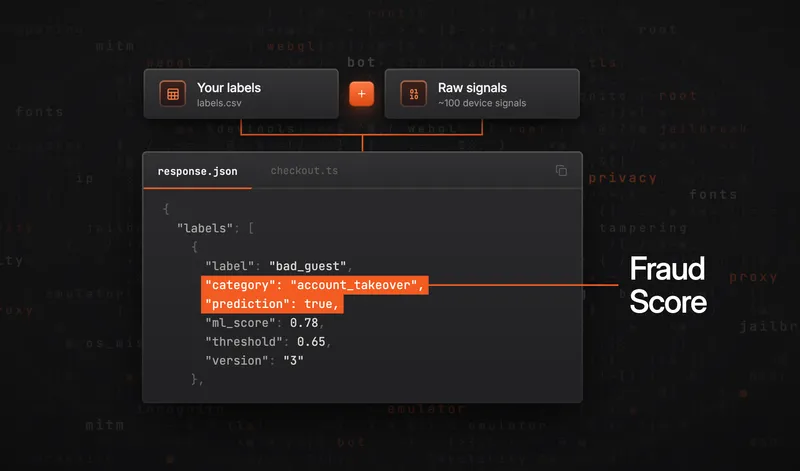
- Fraud Score gives you a specialized model for each type of fraud you fight, trained on your own confirmed fraud.
- Detection for four new AI agents: Meta Muse, Grok Bot, Instinct, Claude Duet
- Install with AI: Take Fingerprint from zero to production-ready in minutes with a single prompt in your AI coding tool
- Real-Time Proxy Detection: Identify a newly activated proxy the instant it is used.
- New dedicated Bots & AI Agents dashboard
- Major improvements to VPN intelligence
- New Compromised Device Integrity signal for Android
- Richer, sharper information to mobile devices: Three mobile releases bring new depth to iOS and Android.
Together, these releases turn your own fraud outcomes into decisions, make Fingerprint easier to deploy, give you clearer answers about suspicious traffic, and reduce the time required to investigate and act on fraud. Let’s dig in on all the details.
Fraud Score
Fraud Score gives you a specialized model for each type of fraud you fight, trained on your own confirmed fraud. Every identification event comes back with a score for each fraud type alongside your visitor ID and Smart Signals.
Fraud is not one problem, and most fraud scores treat it like one. You share a file of the fraud your team has already confirmed, such as account takeovers, promotion abuse, fake accounts, or payment fraud, along with events you know are legitimate. Fingerprint combines those outcomes with a broader set of device intelligence signals and trains a separate model for each fraud type under the label you choose.
In a head-to-head evaluation, Fraud Score caught nearly 50% more fraud than one customer’s existing in-house model with no increase in good customers blocked, and it retrains as you send new outcomes so your models keep up as fraudsters change tactics. Fraud Score is available today as a paid add-on for Enterprise customers using Smart Signals, with a waitlist open for self-serve customers.
New AI Agent Detection Launches
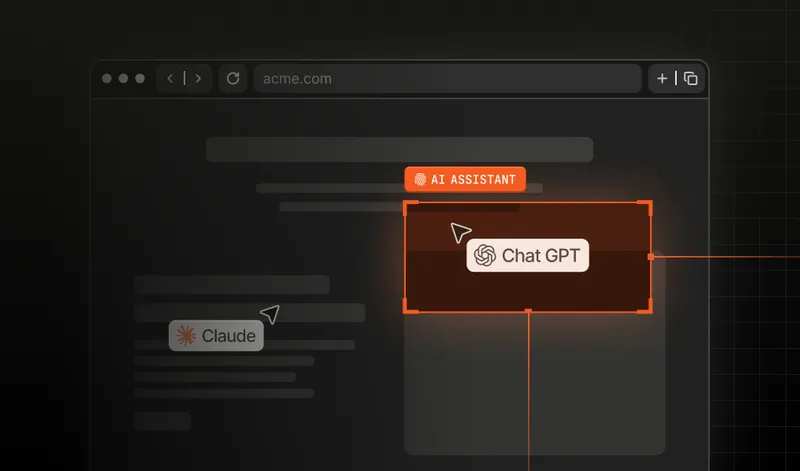
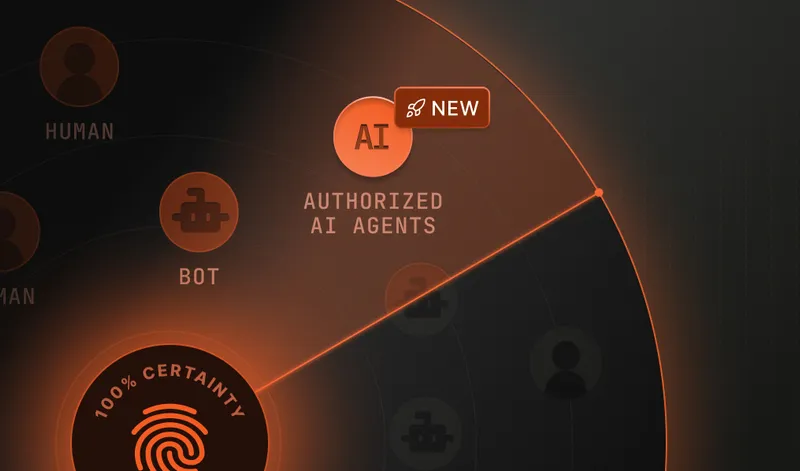
AI agent detection now identifies four more agents by name in the Bot Detection Smart Signal. This is in addition to our already-launched detection for OpenAI’s ChatGPT Agent, Google’s Gemini Deep Research, Anthropic’s Claude Code, and Perplexity. None of the new agents declares who it is, but Fingerprint identifies each one anyway and returns the agent name, category, provider, and a confidence level on the event, so you can set a policy per agent in the Rules Engine or your own systems.
- Meta Muse: Muse is Meta’s personal AI agent. It can sign in to accounts, apply promo codes, and complete purchases on a user’s behalf from a real browser, and it hides its automation signals entirely. Detecting it by name lets you welcome legitimate Muse-driven purchases while adding a review step where it touches promo codes or account changes.
- Grok Bot: xAI’s Grok Bot stopped signing its requests in October, so it now arrives looking like an ordinary visitor. Fingerprint still identifies it, so you can keep treating Grok-driven visits as trusted agent traffic for content and search while blocking anything impersonating it.
- Instinct: Instinct is reached by text message rather than a visible browser and runs bookings and purchases in the background. Naming it lets you rate-limit it on limited inventory like reservations or ticket drops and add a check at checkout, instead of seeing it as unexplained automation.
- Claude Duet: Anthropic’s Claude Duet is the newest addition, with detection rolling out to all plan tiers the week of November 9 on the same schedule as Grok Bot. As with the others, it is identified by name so you can decide how to treat it.
All four are included at no additional cost for Smart Signals customers via the Bot Detection Smart Signal, and each can be filtered by bot name in the Dashboard or watched through the Server API or MCP server.
Install Fingerprint with AI
Install Fingerprint with AI is the first AI-powered onboarding path for device intelligence. By running a single prompt in an AI coding tool such as Claude Code, Codex, or Cursor, developers take Fingerprint from zero to production-ready in minutes, right inside the tools they already use.
Start however you like: prompt your AI agent, give it Fingerprint’s documentation, or run a single CLI command in your terminal. Each path detects your stack, installs the correct SDK, and writes the integration, adding frontend identification and server-side verification to your app, with the option to set up a custom subdomain to protect against ad blockers. What can take days or weeks with other device intelligence providers takes minutes with Fingerprint.
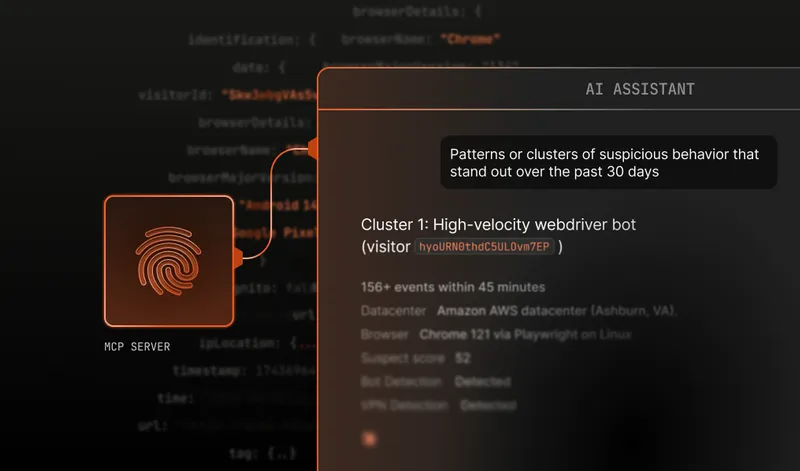
The value continues after install. Your agent offers to connect the Fingerprint MCP server, so your team can query events, investigate fraud, and manage your workspace in natural language. Install with AI is available on all plans, including the free tier, and existing customers can connect the MCP server today with no reinstall.
Real-Time Proxy Detection
Fingerprint now provides real-time proxy detection directly, identifying a newly activated proxy the instant it is used. It examines how a connection behaves while it is in use, rather than relying only on whether the IP address was previously associated with a proxy.
The result is returned through the Proxy Smart Signal on the same identification event. Existing rules that use the signal automatically benefit, with no new integration or permissions required, and the detection arrives with the same confidence you already rely on from the signal.
This closes the delay created by traditional reputation lists, particularly when residential proxy providers rapidly rotate through new IP addresses. Your team can identify proxy-driven account takeover, fake signups, and promotion abuse the moment a new address is used, before it develops a known history, and act on it in real time.
Bots & AI Agents Dashboard
The Bots & AI Agents dashboard gives automated traffic a dedicated place in the Fingerprint Dashboard. The overview shows your bot rate, how much traffic comes from AI, and how detections break down across verified, signed, spoofed, and unknown identities.
You can also see the leading bot categories, providers, names, countries, and networks. The Events view opens individual detections so you can understand where a request came from, what it claimed to be, and how Fingerprint classified it.
This helps you treat automated traffic deliberately. You can welcome trusted agents and useful crawlers while identifying impersonators, scrapers, credential-stuffing tools, and other unwanted automation.
VPN Origin Country Inference
VPN Origin Country Inference is a Smart Signal enhancement that adds the visitor’s likely origin country to the VPN Smart Signal when Fingerprint has sufficient device evidence, even when the VPN makes the connection appear to come from somewhere else.
The feature uses signals from the device to look beyond the VPN exit location. When the available evidence is ambiguous or appears to have been manipulated, Fingerprint can leave the result unknown rather than provide a weak answer.
This gives you better context for investigating account sharing, regional pricing abuse, licensing restrictions, and suspicious cross-region activity, and it helps you enforce and evidence any obligation under local, state, or federal law to restrict access by country. It enriches the VPN result you already receive without changing how your existing VPN detection works.
Compromised Device Integrity for Android
Compromised Device Integrity is a new Android Smart Signal that tells you whether the device environment your app is running on can be trusted. It is available now for eligible plans from Android SDK 2.6.0+ through Server API v4, including webhooks and sealed results.
The signal checks the device’s hardware trust chain: whether the bootloader is locked, whether the operating system is unmodified, and whether the system’s security enforcement is active. It returns true when an integrity issue is found and false when the device checks out, and it contributes to Suspect Score with a default weight of 10, so you can act on it through a score threshold or on its own.
This complements Rooted Device Detection, which looks for active rooting tools, by covering devices with an unlocked bootloader or unverified boot state where no rooting framework is present. You can step up authentication at login, require extra verification for payee changes or transfer limit increases, or escalate to review when it fires alongside Rooted Device, Frida, or Tampered Request, matching the response to your risk appetite.
Mobile Identification Gets Sharper
Three mobile releases bring new depth to iOS and Android.
- Mobile SDK 4.0.0: Mobile SDK 4.0.0 brings both platforms onto Fingerprint’s v4 API. It provides a cleaner response, more consistent errors, and access to Suspect Score when available. Because it is a breaking release, follow the migration guides linked below when upgrading.
- Device details in the response: A new device_details object adds manufacturer, model, and OS version to the V4 Server API response, webhooks, and sealed results. These fields are available across plans. Full OS-version details require iOS 2.3.0 or later or Android 2.17.1 or later.
- Factory Reset Detection accuracy: Factory Reset Detection is also more accurate on Samsung S and A series and Xiaomi Mi and Redmi devices. The update reduces false positives on these models and requires no integration change.
Plus, two new migration guides: Migrating the Fingerprint Android SDK to v4.0.0 and Migrating the Fingerprint iOS SDK to v4.0.0.
Closing
These releases turn your own fraud outcomes into decisions, make Fingerprint easier to expand, and bring hidden risk into view faster.
Fraud Score gives every type of fraud you fight its own model, trained on the fraud your team has already confirmed. The new installation path, detection capabilities, and Dashboard views provide clearer answers about AI agents, proxies, bots, VPNs, device trust, and mobile devices.
Want to see how these updates can work together in your fraud stack?
All article tags
- Product Updates