Summarize this article with
For nearly two decades, web security teams have operated under a simple rule: block the bots. That approach made sense in an era where automation primarily meant scraping, fraud, and abuse. But the web is changing. Today, AI agents are performing legitimate work on behalf of users and businesses — from automating operational tasks to assisting with purchasing decisions. Treating all automation as a threat is now both inaccurate and counterproductive.
The fundamental challenge ahead is no longer “How do we stop automation?” but rather “How do we determine whether automated traffic is legitimate?”
Why this matters
AI agents are becoming a first-class actor on the internet. They are increasingly capable of performing tasks that previously required human involvement, including summarizing documents, checking inventory, updating CRMs, booking shipments – not to mention, shopping and transacting. For enterprises, the upside of these workflows is substantial: faster support, reduced manual effort and overhead, and new revenue streams.
But until now, organizations have had no reliable way to distinguish an authorized AI agent acting on behalf of a legitimate user from a malicious bot impersonating that same activity. The result is an impossible choice: block all automation and break useful experiences, or allow all automation and expose the business to security and revenue risk.
This ambiguity is especially costly for industries like e-commerce, fintech, logistics, and SaaS, where the ability to separate legitimate traffic from fraud attempts directly affects revenue and trust.
Authorized vs. unauthorized automation
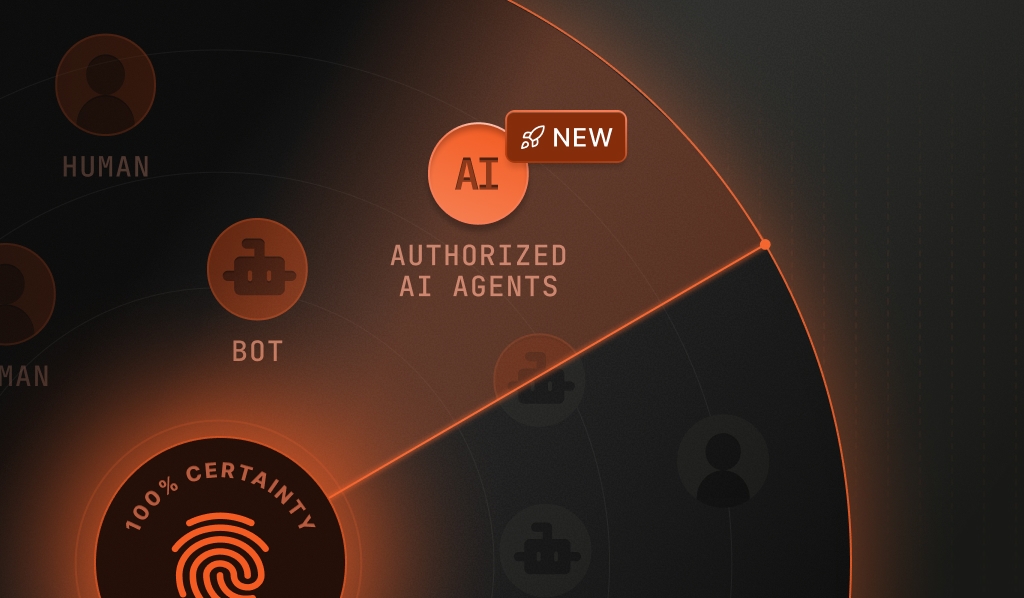
With the launch of Authorized AI Agent Detection and our ecosystem of signed AI agents, organizations can now detect and identify authorized agentic AI with 100% certainty. Instead of relying on generic bot heuristics, companies gain clear visibility into who — or what — is interacting with their digital properties.
This distinction unlocks meaningful outcomes:
- Enterprise automation. AI agents can access permissioned systems without being flagged as threats.
- Operational efficiency. Routine work can be automated safely at scale.
- Agentic commerce. AI agents can safely browse and evaluate products on behalf of users — comparing options, identifying the best offers, and completing purchases — without exposing businesses to fraud.
- Stronger fraud prevention. Malicious bots and scrapers can be blocked without breaking legitimate automation.
AI agents from leading providers like OpenAI, AWS AgentCore, Browserbase, Manus, and Anchor Browser can now be cryptographically verified through our ecosystem, enabling organizations to adopt agent-driven workflows without compromising security. With this launch, Fingerprint now detects the highest number of signed AI agents on the market, establishing a new standard for visibility and verification in the AI era.
Building infrastructure for the agentic economy
Every major shift in internet architecture has required new primitives — identity, authentication, encryption, and trust. AI agents represent another shift, one that will demand new infrastructure to verify identity and establish permissioned interactions between machines.
The old model of “stop the bots” is no longer sustainable. As automation becomes more capable and more legitimate, the real challenge is determining whether a visitor — human or agent — is authorized and trustworthy. Organizations that can differentiate trusted automation from suspicious traffic will retain their competitive edge.
This is ultimately a question of intent. If organizations can accurately identify traffic, they can decide how to handle it — allow, block, throttle, or enrich — based on business context rather than blunt categories like “bot” or “not bot.”
Future outlook
In the near term, we expect enterprise automation to lead adoption. Research and early customer conversations show that companies stand to save significant operational cost by allowing AI agents to perform repetitive workflows across systems that lack clean API integrations.
Longer term, we believe agentic commerce will emerge — where AI agents assist consumers with researching, buying, or booking goods and services. Companies that prepare for this shift early will be better positioned to differentiate through user experience, speed, and trust.
Preparing for the agentic era
The security community has always understood that blocking everything is not a strategy; it’s a temporary defense. As automation becomes central to how the web operates, the ability to distinguish authorized agents from unauthorized bots will be a foundational requirement for digital business.
Authorized AI Agent Detection introduces certainty into a domain that previously relied on guesswork. It allows organizations to remain secure without slowing down innovation — and to capture the benefits of AI-driven automation while keeping fraud and abuse in check.
We’re still early in this transition, but the direction is clear: the web is evolving from a human-only environment to a hybrid ecosystem of humans, agents, and bots. Visibility and identity are the first steps to making that ecosystem work.