What is Claude Duet?
Claude Duet is Anthropic's new personal AI agent, and it can read inboxes, sign in to websites, and make purchases for real users who message it like a person. Users text or send voice messages to Claude Duet, hand it a job, and get updates as the work gets done.
Each Claude Duet works from its own computer in the cloud, so it keeps going after its user closes the app. Where a site has no connector, Claude Duet uses its own cloud browser.
To the websites it visits, a Claude Duet session looks like a person at a browser: It loads pages, fills in forms, signs in with real credentials, and checks out with a one-time card from Link or Shop Pay.
Claude Duet launched as a research preview for Claude Pro, Max, and Ultra subscribers in the US, with access opening in waves from a waitlist. Volume is low today. It won't stay that way for long.
That makes Claude Duet useful to the people who rely on it. It also makes Claude Duet hard to tell apart from them.
Why is Claude Duet so difficult to detect?
Claude Duet is built on Claude, but it isn't the Claude your site may already recognize. It isn't a chat assistant fetching a page on request. It's an agent acting on a user's behalf, inside their accounts, from its own browser.
Anthropic says Claude Duet is designed to identify itself as an agent: its browser sends a distinct User-Agent header, and Anthropic publishes the IP addresses it browses from. That's a declaration, not a cryptographic signature like Web Bot Auth.
Three things make it hard to catch:
- A declared identity can be copied. A User-Agent header is just text, and anyone can send one. A header that says Claude Duet proves nothing on its own.
- No automation flags. Claude Duet runs a real browser in the cloud, so the flags most bot detection depends on never appear.
- No telltale behavior. It signs in with the user's real credentials and pays with a one-time card the user approved, so account and payment checks see an ordinary customer.
This is why declared identity can't be your only signal. Anthropic says it will keep refining how Claude Duet identifies itself, and policies built on a header alone can break when it does.
For fraud and security teams, that raises an uncomfortable question: How do you know an agent is who it says it is?
Identifying visitors, even ones who don't introduce themselves, in a privacy-preserving way is the problem Fingerprint was built to solve. Our Bot Detection Smart Signal now labels automation inferred to be Claude Duet directly in its response, separate from the Claude assistant traffic we already verify.
Claude Duet joins a roster of AI agents and assistants Fingerprint already identifies, including xAI's Grok Bot, Meta's Muse, OpenAI's Cloud-Based ChatGPT Agent (Dots), Google's Gemini Deep Research, Anthropic's Claude Code, and Perplexity, with many more catalogued in our Bot Directory.
How to detect Claude Duet step by step
Step 1. Install Fingerprint on your website. You can start with a free account and start seeing data in minutes.
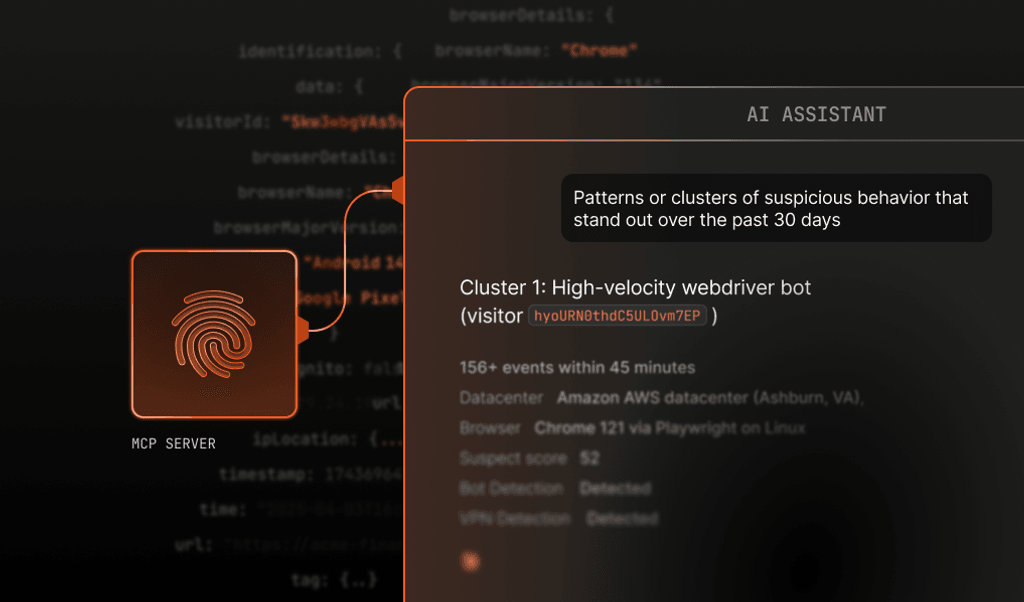
Step 2. Look for Claude Duet in your bot detection results. Using our Server API or MCP server, check for bot_type: "claude_duet", or filter our dashboard for events with the bot name "Claude Duet".
When Claude Duet appears, the detection response includes:
{
  "bot": "good",
  "bot_type": "claude_duet",
  "bot_info": {
    "category": "ai_agent",
    "provider": "Anthropic",
    "provider_url": "https://claude.com/product/claude-duet",
    "name": "Claude Duet",
    "identity": "unknown",
    "confidence": "high"
  }
}
Here's how to interpret the result:
bot_type: "claude_duet"identifies automation inferred to be Anthropic's Claude Duet.category: "ai_agent"classifies the traffic as an AI agent.identity: "unknown"means the agent is recognized, but no verifiable identity was presented.- confidence reflects confidence in the inference and can be
"high","medium", or"low".
Step 3. Apply rules and policies. Use our rules engine or your own system to decide what happens when Claude Duet reaches your site, whether that's allowing it, adding friction on sensitive flows like login and checkout, or blocking it.
It's worth noting that Fingerprint classifies Claude Duet as a "good" bot because it declares itself as an agent. That classification describes how it identifies itself, not what it should be allowed to do. You might give a declared agent more latitude than anonymous automation, but an agent acting inside a customer's account still has to earn trust one action at a time.
Start detecting Claude Duet today
If you're already a Fingerprint customer with Bot Detection, Claude Duet detection is included at no additional cost. Contact our support team to get started. (To protect our more algorithmically sensitive customers, some of whom require advance notice of model changes, we're rolling this out on a staggered basis. Claude Duet sessions that were previously flagged as generic browser automation will now be identified by name, so if you have rules based on bot: "bad" or chromium_automation, you may see a small change in the traffic they match.)
If you're not yet a Fingerprint customer, you can start for free today and start detecting Claude Duet traffic, or talk to our team about how it fits into what you are building.