Summarize this article with
Security and fraud teams need faster, simpler ways to understand who’s visiting their sites and act on that information in real time.
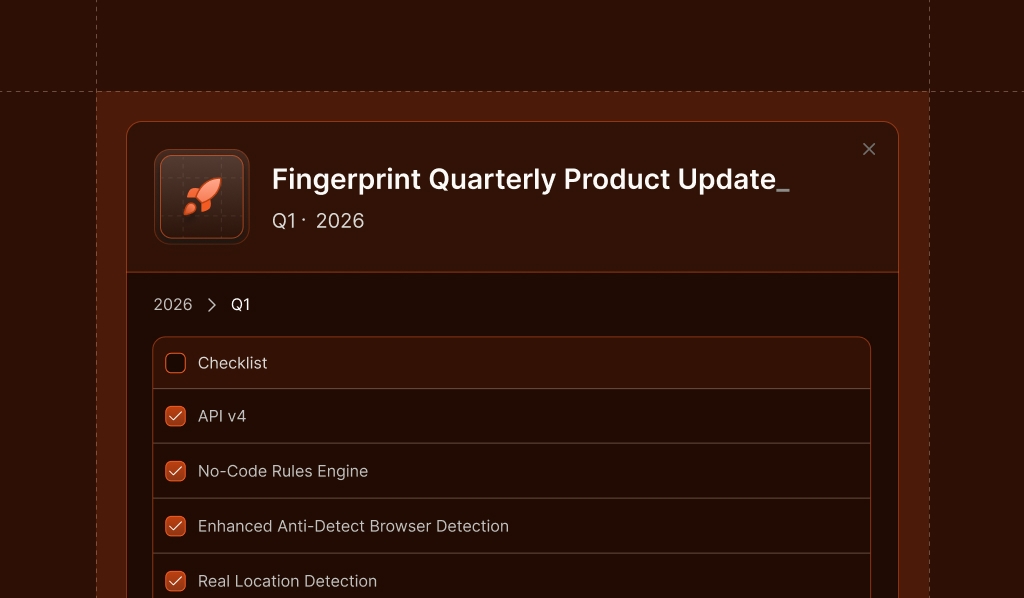
This quarter we introduced major updates to Fingerprint to make device intelligence easier to use and faster to act on.
API v4: A simpler, unified foundation for device intelligence
Fingerprint’s API has grown alongside the platform to support more signals, endpoints, and configurations as fraud use cases expanded. While this flexibility enabled powerful integrations, it also introduced additional complexity.
API v4 delivers a simpler, more consistent foundation that unifies data formats across Fingerprint’s core components, reduces payload size, and makes integrations easier to build and maintain now and in the future.
With API v4, teams get:
- A unified data model across Fingerprint surfaces, so responses are easier to read, reuse, and reason about.
- Smaller, more efficient payloads for faster performance.
- A more future-proof structure so Fingerprint can ship new capabilities without breaking your integration.
For customers, this means less integration overhead and simpler long-term maintenance, especially as you adopt new Fingerprint features over time.
For a deeper dive into the technical changes, read our full API v4 announcement. For implementation details, see the Server API and JavaScript Agent migration guides.
Enhanced Anti-Detect Browser Detection: Surface fraud designed to blend in
Fraudsters increasingly rely on manipulated browser environments that attempt to rotate fingerprinting signals and spoof device characteristics to appear as legitimate, first-time users. This technique is commonly used for account takeover, multi-accounting, and promotion or subscription abuse, and is difficult to catch with traditional bot or IP-based defenses.
We’ve rolled out major enhancements to our anti-detect browser detection, significantly expanding coverage and improving detection of sophisticated browser manipulation that previously blended into normal-looking traffic. By analyzing inconsistencies within the browser environment itself, it helps teams:
- Surface fake identities created by manipulated or synthetic browser setups.
- Detect abuse that hides behind clean IPs and realistic device profiles.
- Separate high-risk automation from legitimate, low-risk automated traffic.
This detection gives fraud and risk teams clearer signals and higher confidence when investigating or taking action.
Availability: Enhanced anti-detect browser detection is available to Smart Signals customers.
Real Location Detection (mobile): See past VPNs to reveal true device origin
Traditional VPN detection highlights when a request is masked — but not where it’s actually coming from. Our enhanced Real Location Detection goes a step further by inferring a user’s real country, even when a VPN is present. This helps teams move beyond “VPN = risky” assumptions and identify meaningful mismatches between reported and real device location.
By surfacing these mismatches, teams can:
- Flag suspicious behavior: Detect cases where VPN location differs from inferred device origin.
- Enforce geo-based policies: Catch circumvention of regional restrictions (country-level).
- Stop location-based fraud: Prevent promo abuse, referral fraud, and unexpected-region account takeovers with country-level real location data.
This signal becomes even more powerful when combined with VPN Detection, Proximity Detection, and Bot Detection.
Availability: This capability is live now for both iOS and Android. Learn more in our documentation.
No-code rules engine to act faster on device intelligence
We’ve heard from our customers that building and deploying fraud rules can take days or even weeks — which simply isn’t good enough in an era where attackers move faster than ever and patterns change constantly.
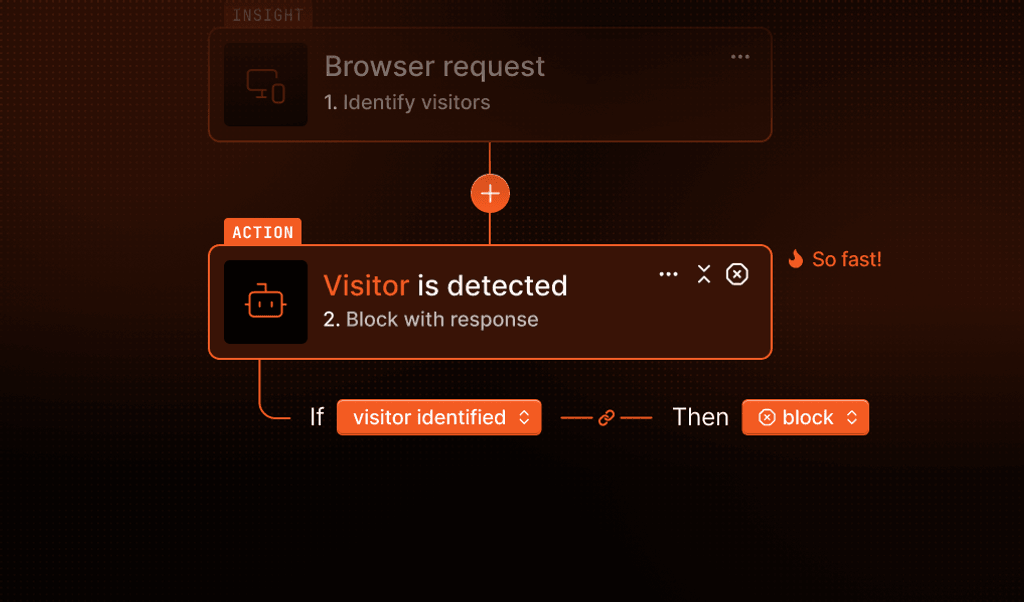
That’s why we launched a no-code rules engine that allows fraud and non-technical teams to build and deploy rules on the spot, with minimal engineering resources required. Teams can now build fraud rules based on more than 60 device and browser signals by using simple if-then logic in a visual interface.
Availability: The no-code rules engine is available now. Customers can begin building and deploying rules today. Reach out to customer support if you would like help getting started.
More control and visibility in the dashboard
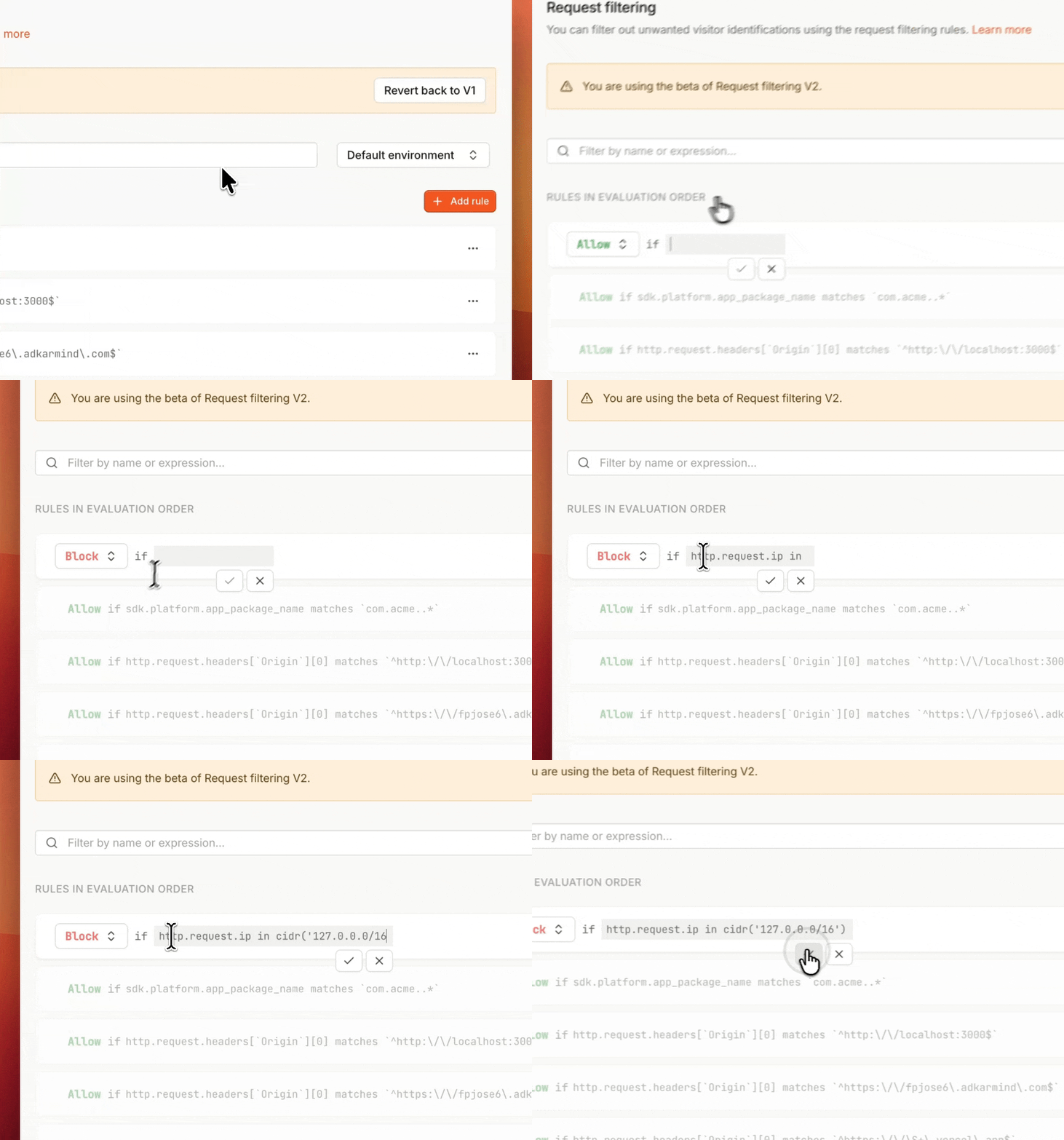
Alongside major platform updates, we also shipped several improvements that make it easier for teams to operate Fingerprint day to day with more clarity and confidence.
Teams can now filter unwanted traffic more precisely with a more flexible request filtering system, reducing noise and unnecessary billing (currently in beta). Operational workflows are smoother as well, with new Management API support for automating encryption key rotation instead of relying on manual processes. For teams managing multiple integrations, improved API key monitoring adds per-key visibility into usage, latency, and throttling, making it easier to identify issues early.
We also expanded the identification events table to surface more data at a glance, including Smart Signals, so investigations can move faster without opening individual event details. New alerts management gives teams control over alert types, frequency, and recipients, reducing notification noise, while a new audit log provides a clear record of changes across the dashboard, improving transparency and security for larger teams.
Together, these updates improve observability, reduce operational overhead, and give teams more control as their Fingerprint usage scales.
Availability: These updates are available in the Dashboard and Management API today. For setup details, see the documentation for request filtering (beta), Management API, API key monitoring, alerts management, and audit log.
That’s a wrap
This quarter’s releases focus on simplifying integrations, strengthening defenses against sophisticated automation, and helping teams act faster on device intelligence.
Need help with any of these updates? Contact our team for guidance or book a demo.